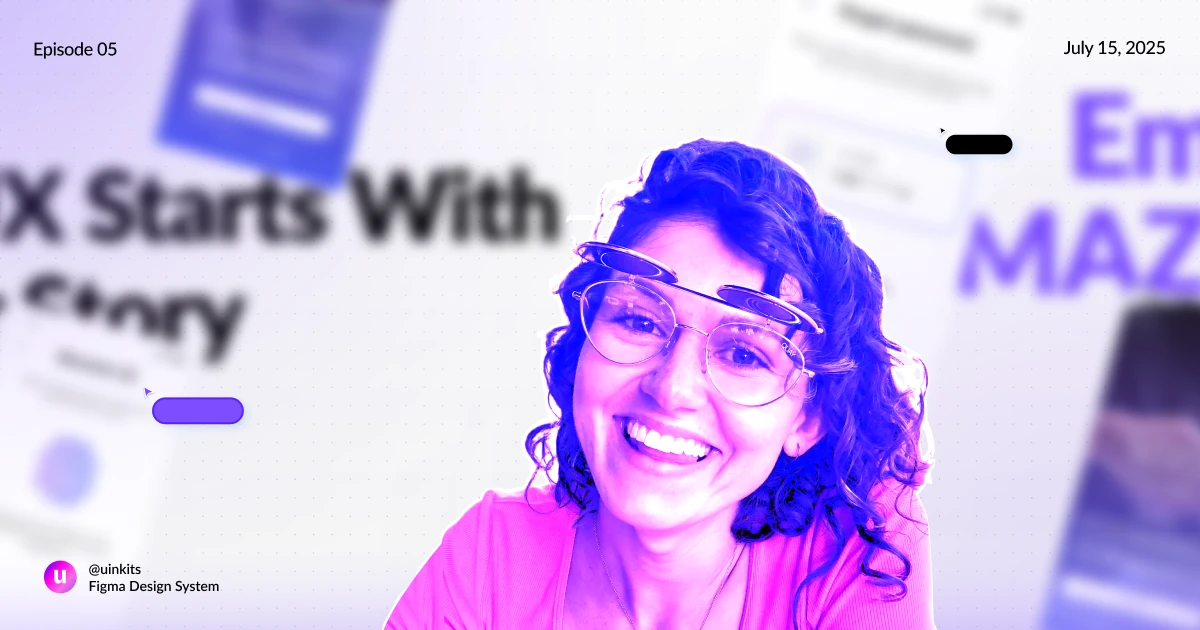

“My dream project is just having the opportunity to learn something new, grow, and solve interesting problems with cool people.” – Emilie Mazurek, Senior Product Designer, Mentor & Creator.
The core of every great designer is the deep desire to grow – in skill, perspective, empathy, and, well, overall as a person. Not everyone wakes up one day knowing exactly what they want, especially in UI/UX design. Sometimes, it takes a few pivots – or maybe even entire career detours – before it all starts to click.
That’s precisely what makes Emilie Mazurek’s story just so relatable. Her path into UX was “unconventional”, as she calls it. Actually, she didn’t even start with a background in design (of any kind).
In fact, she was at first a scientist who worked in a microbiology lab and applied for medical school – three times; a marching band instructor who loved playing the saxophone and taught music through movement; and even spent a decade in restaurants, working her way up from a hostess to a waitress and even some part-time management work.
For many designers, this is just the perfect example that growth doesn’t always come from having a perfect plan laid out. Sometimes you head in a specific direction, without realizing it might not be quite right. Not yet, at least.
Although Emilie was set on medical school, it was through career counseling that she discovered another path – one that spoke more to her creative instincts and problem-solving skills. And as it turns out, design was the better fit.
This was the real turning point in Emilie’s journey. Sitting down with a professional and going through her strengths, weaknesses, and interests, a conversation that gave her the clarity and confidence to pursue a career in design.
Now, she wants to do the same for others – using her platform to share honest insights, support, and encouragement with anyone trying to find their own path.
Our path, our experience, our perspective – our story – is often one of the most underrated assets we bring into design. But in Emilie’s eyes, it’s the reason she ended up thriving in UX design.
She always jokes about how, if you’d seen her resume, you’d see anything but something related to design. “If you’d looked at it”, she says, “you would’ve been like, ‘What is this résumé doing in the pile?’ It’s obviously in the wrong pile”.
Indeed, her experience might not look like the perfect fit for the designer role. But each of these roles, as different as they seem, taught her something she still uses today. So, what might seem like a random mix of multiple skills and career directions, they are the foundation of what makes us better designers.
Whether it’s the analytical thinking or detail-oriented skills that she gained from both her scientific background and her role as a marching band instructor, both have helped build a strong foundation. But it was the soft skills that she gained while working in restaurants that became the most valuable in her UX work.
Communication, teamwork, problem-solving, and listening – all of these are precisely what one needs to be a successful UX designer. This is why Emilie credits her experience in the restaurant as the one that shaped her empathetic approach to design and working with other people. And it’s true!
“Look at the overlaps. So many people disregard their past as irrelevant to design, and it just couldn’t be further from the truth. Even if it’s a loose correlation, there is always some overlap.”
So, at the end of the day, it’s no wonder that what helped Emilie succeed in UX are, in fact, the soft skills. Years of handling tough conversations, thinking fast, staying calm when everything is chaotic, knowing how to listen to what people really mean, and working and talking with all kinds of people.
In other words, exactly what user experience is all about.
The truth is, while many of us recognize the importance of soft skills, it’s easy to get caught up in focusing on technical aspects early on. But it’s not always about the latest design tool or fancy research methods (although they do have their purpose). Instead, user experience represents designing with people and for people.
Emilie’s story is a reminder that sometimes the things we pick up in the most unexpected places end up being the most useful in the work we do today. Even though it may just be a customer telling you that “I need to be in and out of the restaurant in forty-five minutes”, we have to be prepared to say to them “Okay, great, these are the five items I recommend you order, because they can get put out really quickly”.
So, no matter if your background has always been focused on design or not, it all comes down to one thing: “lean into your past. That’s what differentiates you from ‘every other bootcamp grad’.”
Unfortunately, many designers get stuck because they doubt themselves or feel overwhelmed – I’ve been there, Emilie has been there, and even you reading this have probably been there.
Advice is everywhere in the design community – blogs, podcasts, webinars, and endless social media posts. So, what truly makes a difference, especially in mentorship? Giving others the confidence they need to move forward.
“People are so much further ahead than they recognize. So it’s not necessarily advice that I’m giving, it’s really just a little confidence boost most of the time.”
That boost can be precisely what we need to trust the process. Often, we already know what we need to do next – we just need someone to reaffirm that yes, we’re doing a great job.
At the same time, not everyone can relate to the top achiever who’s got 100K followers on LinkedIn or Instagram, or was an intern at Google at 18. We can only look up to them and hope that we’ll end up like them.
This is why Emilie puts so much emphasis on authenticity when she speaks publicly. She wants to do more than just dish out generic advice or share a polished success story – she wants to be honest and relatable. This is what makes her a truly amazing mentor.
“I always try to just be authentic.”, she recalls. “And I think people resonate with somebody genuine”.
And she wants us to be the same: authentic, real, and unafraid to show the messy parts of our stories as well. That’s where genuine connection happens.
This is the same honesty that inspires her to speak openly about things like burnout, layoffs, and rejection as well. Emilie believes that by bringing these topics into the light, she can help create a more supportive and understanding UX community – one where it’s okay to struggle, to stumble, and, well, to ask for help.
“It happens to so many people all the time, and nobody's talking about it.”, especially in the public scene, she explained. And the reality is that in those precise moments, this is the time we need someone to tell us “hey, it’s okay” and give us a confidence boost.
When we hear UX design, our first thought is “user-centered design”. And for good reason. After all, this is the heart of what we do. But Emilie Mazurek challenges us to look beyond that familiar phrase by calling it a “delightful UX.”
“User-centered design is the most overrated, right? That's the one we all love. We'll always use it in our bios and our headlines – and guilty as charged, right?”, she says jokingly. “But I think strategy is the most underrated”.
Of course, user-centered design is what user experience is all about, “it’s literally in the name”. So naturally, everyone will try to focus on it. The same goes for research. Here, however, the real gap is whether they actually do it and how well they do it.
But strategy? That’s often the piece that gets lost. In theory, we all know the real value of a well-done strategy. Unfortunately, even Emilie is aware that not everybody knows how to implement it. So, not everybody is doing that. This is where many designers, especially those who are juniors or maybe even intermediate, haven’t yet developed their skills.
Strategy is more of a senior mindset, one that ties research and design together – that’s the real meaning of “Delightful UX”.
For Emilie, delight is also in the little things – the thoughtful surprises that make you pause and smile. In fact, she gave us a very cute example of when she first got her new iPhone.
“I had the radio on, and it synced with my phone, which is cool. And I can control it from my phone to the speaker.”, she recalls, “And when I was pushing the up button on the side of the phone, the UI on the left side of the phone indented in every time I pushed the button.”.
It didn’t need to do that. But it did. And that made the user (Emilie) happy.
That’s the kind of detail that no usability test would ever demand, but users remember. Sure, we may have this clean and minimalist design, where every component is in its place. It’s clear in terms of user flows and the patterns we want people to follow. But little things like that – “unexpected and fun” – they are like “the icing on the cake”.
“Having a great user experience throughout is the most critical part, but delight, to me, brings a little spark of joy.”
Emilie has built a truly powerful voice in the UX world – especially on LinkedIn. But she admits that learning goes both ways. “There's still so much more for me to learn.”
She expressed so much gratitude towards the people who interact with her, whether it’s through a comment, a message, or even by joining her mentorship sessions. But for someone always eager to learn new things, Emilie is thankful that her experience opened a two-way conversation, where new perspectives and resources keep her inspired every day.
This is exactly what has helped her find her unique voice in a crowded space. She felt as if this exchange made her connect with people from the community since a lot of people also wanted to transition from an “unrelated field to UX design”.
“My story was relatable and felt achievable. I was just sharing little tips that I found helpful, and that resonated with so many people who wanted to follow a similar path.”
Finding our voice or inspiration doesn’t come only from endless Pinterest boards or social media content. Nope. For Emilie, it came from leaning into who she is beyond the screen – especially traveling. “I’ll find any excuse possible to book a vacation”, she jokes.
This spirit of curiosity, of embracing the unknown, and learning through experience, these are the things that drive Emilie Mazurek forward. Whether it’s design, travel, mentoring, saxophone, or even trying something new, she’s never chasing a perfect formula.
She’s chasing what feels exciting – this is the key to a delightful UX design and becoming a better designer. “I'm learning every day, which is just so exciting” – Emilie Mazurek.